
An assessment can feel like a lot of moving parts: decisions about where to go, appointments, testing sessions, a thick report, and a set of next steps that are not always obvious. This page maps the journey from start to finish, so you have a rough sense of what happens at each stage and where to turn when questions come up. Whether you are a parent reading a child’s report or an adult reading your own, the overall shape is broadly similar.
A quick note before you start. ReportDecoder does not perform assessments or interpret specific results. This page gives a general overview of a typical assessment, and the professional who did the testing is always your best guide to what your specific results mean. No two assessments follow exactly the same path, so treat the stages below as a typical arc rather than a fixed script. Yours may look a little different.
Want the short version? Here is a one-page handout of this whole map. Save it, print it, or bring it to an appointment.
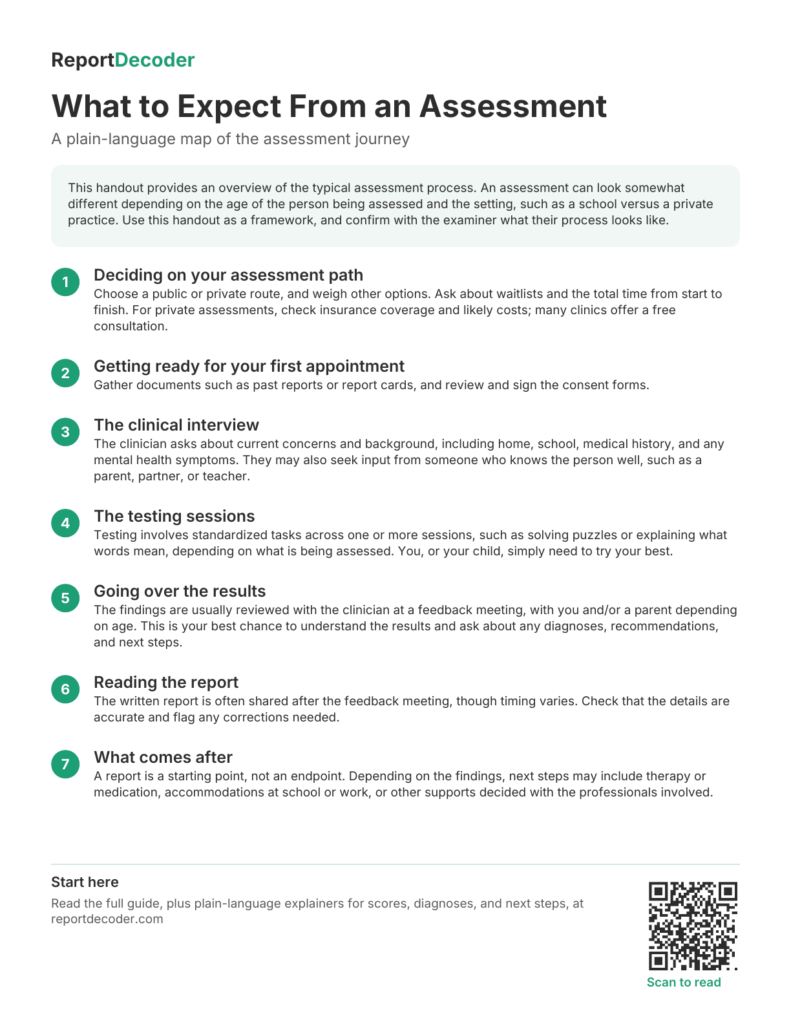
Download the handout
A one-page overview you can print or save, free and with no sign-up. The color version is best for reading on screen or printing in color. The print-friendly version is designed for clean black-and-white printing.
Deciding on Your Assessment Path
The first real decision is usually whether to pursue a comprehensive psychological assessment versus a more brief psychiatric assessment. Our guide on psychological versus psychiatric assessments will help you decide which pathway is more appropriate for your case. Look into both options so you can weigh the pros and cons for your situation.
Depending on your age, where you live, and what is available locally, an assessment might happen through a school or another publicly funded route (hospital or community mental health clinic), or through a private clinic. Publicly funded options are often low or no cost but can carry long waitlists, sometimes a year or more. You may need to submit a formal request for assessment through the school or get a referral from a doctor for certain clinics.
Private practice clinics tend to have shorter waits, often several weeks to several months, though this varies widely by area. You don’t usually need a referral to get testing through a private clinic. If you are considering a private assessment and have insurance that may apply, contact your insurance provider early to learn what is covered and to get an estimate of the costs you would be responsible for. Learn if the private clinic is on the approved list for your insurance. Ask if the private clinic can direct bill the insurance provider, which is nice to have but not required.
Many private clinics also offer a brief no-cost consultation, which is a good chance to ask questions and check that the process fits what you need. Weighing public against private is a bigger topic than this page can cover; our guide on public vs private assessments goes deeper.
Getting Ready for Your First Appointment
Once you are booked, a little preparation helps. The clinician may ask you to gather relevant documents ahead of time, such as any previous testing or reports, recent report cards, or notes from a teacher (with a child, information from school can be useful). You will also review and sign consent forms that explain what the assessment involves and how the results will be used. This is a good moment to write down the questions you are hoping the assessment will help answer.
The Clinical Interview
Most assessments include an interview where the clinician learns about your history, concerns, and day-to-day experience (a clinical interview). For a child, this often means talking with parents, and sometimes gathering input from teachers or others who know the child well (collateral information). For an adult, it centers on your own account, and sometimes a partner or family member. The order can vary. The interview is often near the start, but some of it may happen alongside or after the testing itself, so do not be surprised if it is woven through the process rather than done all at once.
The Testing Sessions
Testing usually happens across one or more sessions. You, or your child, work through a range of standardized tasks: answering questions, solving puzzles, reading, writing, or recalling information, and sometimes filling out questionnaires. There are no trick questions and nothing to study for. You are simply asked to try your best, and many tasks are built to get harder as they go, so it is normal not to finish every item. Clinicians use several different tools rather than one, because no single measure captures the whole picture. If you want to see the specific tests that may appear in a report, our overview of the tests walks through each one.
Going Over the Results
Once scoring and interpretation are complete, many clinicians hold a meeting to walk you through what they found (a feedback or results meeting). They explain the scores, describe patterns, answer your questions, and talk through any conclusions and recommendations. Most assessments handle this in a dedicated session, but not every setting allows for a feedback session.
This feedback meeting is a separate event from a school meeting held later to plan supports (an IEP or 504 meeting), which comes after the assessment is finished. Bring your questions to whichever format your clinician uses, and do not hesitate to ask them to slow down or repeat anything. You can use our school support meeting worksheet to help you stay organized as you will be hearing a lot of information.
Reading the Report
The written report is usually shared at or shortly after the feedback meeting. It is often the part that feels most overwhelming: pages of numbers, tables, and terminology. One practical thing to do first is check the background details for accuracy, such as history, dates, and other factual information about you or your child, and let the examiner know if anything essential needs correcting so the final report is right. An examiner gathers and sorts a great many details, so it is normal for a few minor edits to be needed.
From there, you can either stick with a broad understanding of the results of the report. Use our assessment summary worksheet to summarize the assessment into two pages of the most important information.
If you want a deeper understanding of the results, learn how the scores work, since the same number can be labeled differently across reports. Second, look at the profile as a whole rather than fixing on any single score, because the meaning comes from the pattern across strengths and areas of difficulty.
What Comes After
A report is a starting point, not an endpoint. Depending on the findings, next steps might include support at school or work, services such as therapy, accommodations, or simply keeping an eye on things over time. What is realistic and appropriate depends on the specific situation and the professionals involved. Our guide to what comes next lays out the common paths, so you can prepare for conversations about support.
Keep Exploring
- The tests behind the scores: assessment tests
- Reading a score: understanding assessment scores
- If a diagnosis is in the picture: understanding a diagnosis
- More worksheets: the worksheet library
- Browse every guide: the full guide directory